Dieselgate , Electric Vehicles and driverless cars

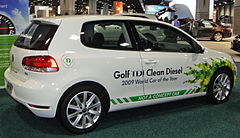
VW_Golf_TDI_Clean_Diesel_WAS_2010_8983

It has been nearly a year since Volkswagen admitted they had intentionally programmed 11 million cars to cheat emissions testing. VW had invested heavily in flawed diesel technology and wanted to max out its investment. Cheating allowed them to market fraudulent ‘clean diesel’ passenger cars as the way forward. Following tax breaks and encouragement to go ‘green’, London licenced diesel vehicles rose to a record 774,513 in 2015. Diesel fuel is responsible for 40% of air pollution in London.

There are 1.1 million people everyday in London who suffer from respiratory conditions and are vulnerable to unhealthy air pollution levels, according to the British Lung Foundation. High spikes in air pollution can also trigger heart attacks and permanently stunt the growth of children’s lungs by up to 20%. Last year Kings College published a paper entitled ‘Health Impacts of air pollution’ Experts believe 9,400 may have died prematurely in 2010 from exposure to Nitrogen Dioxide and PM2.5 particulates, primarily from diesel emissions.

Electric Vehicles are often referred to as ‘zero-emission vehicles’ in London. However in 2010 a Renault advert claiming its Electric vehicles were ‘zero-emission’ was banned by the Advertising Standards Authority. It was pointed out that a vehicle charged using energy sourced from UK national grid would be majority coal and gas powered as renewables only make up a very small proportion of the Electric Grid. This is still the case. There are also additional non-tailpipe emissions caused by brake and tyre wear and production. As Jenny Bates of Friends of the Earth has commented, ‘There is no such thing as a clean car’.

Driverless cars are being marketed in London by the automobile industry as being safer than human drivers. In Greenwich, Ground Drones or self-driving delivery robots are being trialled on pavements this summer, with council permission. However there has been no consultation on the implications for public space. Pavements are a soft target for driverless robots but the creep is noted. There will also be the first trial of autonomous vehicles in UK probably in the boulevards around the O2 as part of The Greenwich Automated Transport Environment project experiment.

At the Hackney Cycling Conference in June, Market Leader James Long of ‘sustainable’ transport consultants Steer Davis Gleave talked about an ‘arms race’ to install driverless vehicles on the streets of London. This was an unfortunate turn of phrase as Stephen Hawking has warned of an ‘Artificial Intelligence arms race’ that is not far off a ‘Terminator’ style nightmare.

In 2015 Fiat Chrysler had to recall 1.4 million vehicles after a car was hacked in US and the software manipulated so that it could be ‘driven’ by remote control. Researchers have shown that autonomous vehicle controls are vulnerable to hacks. Such vulnerability creates a very real security threat. Last month, a Tesla driver was killed by his own car when the sensors failed to detect a tractor in bright sunlight, whilst on autopilot. Bradley Stertz of Audi has conceded that ‘To have a car understand every single possibility is a massive challenge’

However many believe Silicon Valley has few scruples about rolling the dice with public welfare. Uber has already been whining that there is too much ‘safety’.

Producing a driverless car, which aspires to achieve the impossible task of understanding every single possibility, is very costly. A self-driving car costs twice as much to produce as a conventional car. The business case for driverless vehicles only works if there are large numbers or fleets. This vision of mass production of driverless vehicles dominating cities like London has got corporations chomping at the bit. The only problem is that humans get in the way. Cyclists are ‘difficult’ for self-driving cars as they don’t behave like a pedestrian or motorised vehicle. They are also re-programming self-driving vehicles to be more aggressive to override ‘polite’ giving way to pedestrians.

As with other cars, driverless ‘mobile couch potatoes’ in no way address the public health crises of inactivity, urban diabetes and obesity.

Dieselgate is a lesson in just how far car manufacturers will go when they have invested in a flawed technology. Volkswagen thought they could get away with it; and they did, for six years they sold illegal vehicles and the sophisticated software algorithm was not discovered. In fact it was never *found* but offered up only when there was no explanation for the discrepancy between laboratory and on the road emissions. Naively Government had relied on the automotive industry to self-certify. Why would we rely on self-certifying car manufacturers of driverless cars when the technology could be loaded with vulnerable, unfathomable and possibly rigged software? Or worse?

And then there are gremlins. Machines go wrong inexplicably. We have all experienced our computers crashing at our desktop, sometimes at the most inopportune time. Just imagine that scenario sitting at the dashboard of a moving self-driving car on a busy London Street?

Safer London Streets, that are fit for humans, require a significant reduction in traffic says ‘Human Streets – The Mayors vision for Cycling three years on’. In Oslo, car-free plans aim for ‘as little as possible’ motorised traffic, including electric cars, ‘they just take up too much space’.

The Mayor of London, Sadiq Khan, has announced that Oxford Street will be motorised traffic-free to cut unhealthy air pollution and road casualties. Bank junction and Parliament Square may also follow and go car-free.

Of course minimising motorised traffic in London won’t make money for the automobile industry but then again you never see broccoli being advertised on TV!

On the eve of the EU Referendum I explain why I will abstain and profer another way forward

index.jp

Family photograph of mayors in Paris on 4 December, 2015

I have been profoundly disturbed by the ‘civil war’ that has erupted over the EU Referendum. Intelligent, open-hearted, democratic debate has been overtaken by unhealthy polarisation and bullying, and even tragically violence. This has mostly been directed around the issue of immigration.

It may be very useful for some to divide and conquer but this masks a much more fundamental and urgent debate on the really pressing issues of our time, such as air pollution, climate change, obesity/inactivity crises and increasing inequality around the world. And of course the suffocating dominance of corporations.

I do not believe the outdated institutions of centralised Westminster UK Government or the EU are fit for purpose. Both are highly undemocratic, stagnant and disempowering for citizens.

Although I admire Client Earth’s struggle to bring the UK Government into line on EU air pollution limits through the courts, we see how excruciatingly laborious, expensive and time-consuming this approach is. And anyway the EU has now watered down air pollution limits under pressure from the very concentrated, powerful car lobby in Brussels. Our current UK central Government seems even more resistant to addressing this public health issue. We are caught between a rock and a hard place.

Which is why I am proposing that the only way to speed up change is devolved power to directly elected Mayors across the world; this will bring about change both at a local level and collaboration at a global level, as seen at COP 21. I want democracy brought back to the grass-roots, where citizens feel empowered on the streets of their own cities. Public health, housing and environmental issues brought back to the heart of the community.

This is not about the EU block opposed to say the US or the African Group. This is about cities around the world, who are responsible for 70% of emissions, joining together to combat serious and urgent issues.

Centralised bodies like UK Westminster parliament and EU Parliament like to hold on to and increase power, whether through an unrepresentative voting system or Federalism. How easy is it for someone in the Orkneys to protest outside Westminster Parliament or EU Parliament? It is very financially onerous on all but the most well-heeled of society to be incumbent on these centralised institutions.

I understand there are flaws in this system too. What do rural areas do? Can they have a Mayoral system that works for them.? And of course Mayors can be corrupt too.

Some will say the status quo is the best we can do. Personally I believe the status quo is not an option, we are at the precipice. Let’s open up the debate on more dynamic alternatives that are appropriately reactive to the fast-moving times we live in.


Today is Sadiq Khan’s first Mayors Question Time

index
I hope he will be heartened by the wonderful opportunity to transform London in his four year term into a liveable space for humans rather than dominated by motorised vehicles.
I would be happy to share my insight and vision for a car-free city centre and car-free cycling network across Greater London. This adds and expands many of the new projects envisioned in this document, Human Streets.
Boris Johnson – Everyone who cycles is improving not just their own health but other people’s health, because bikes do not cause pollution
Andrew Gilligan – Officially, the cycling programme is about cycling. In reality, it is about breathing. It’s about pollution,about health, about noise, about the kind of city we want to live in. It is about making the best use of scarce space on the roads, about freeing space on public transport

Will the new London Mayor Sadiq Khan hold to his promise of expanding car-free areas across the city, as pledged to ‘Stop Killing Cyclists’ ?

index

“Along with tackling our city’s polluted air and encouraging more Londoners to take up cycling as a healthy alternative to driving, making the capital’s roads safer is one of my top priorities.

“To that end, I am happy to pledge a significant increase in investment for cycling infrastructure, as well as promise to look carefully at taking tipper trucks and HGV’s off London’s roads during rush hour. In order to keep large lorries off the roads during the day time, rules restricting deliveries at night may need to be relaxed so as Mayor I would enter into discussions with local authorities to identify where this might be possible. I will also examine the case for equipping all TfL vehicles with blind-spot safety equipment and support a Mini-Holland Programme for all London Boroughs within my first term.

“I am committed to continuing the investment in the Cycle Superhighways programme and upgrading existing segregated cycle ways to a higher standard. I also want to roll out more 20mph zones in residential areas, having long campaigned for their introduction in my own constituency of Tooting. Moreover, I would be strongly in favour of adopting a variant of the Idaho Law and I have pledged to revise the list of junctions in need of immediate attention, prioritising improving those where the most deaths and accidents have occurred. Doing this is absolutely essential because Londoners must be able to move around their city with confidence and as safely and efficiently as possible.

“That is why I have also committed to pedestrianising Oxford Street and expanding the number of car-free areas across the city. I would also be happy to appoint a representative, nominated by cycling groups, to the board of TfL to ensure that the views and experiences of cyclists are heard at the highest levels within City Hall and acted upon. Furthermore, I will use planning laws to deliver more cycle storage provision in new office and housing developments and I will work with the boroughs to deliver more secure on-street cycle parking in residential areas.”


http://www.bikebiz.com/news/read/boris-was-good-for-cycling-sadiq-will-be-better-say-campaigners/019528


Sadly today I am withdrawing from the #LondonMayor2016

Unfortunately it has not been possible to collect and verify the 330 nomination signatures required to appear on the ballot paper as a Mayoral candidate.

Thank you to all my supporters for your help and guidance. It has been a pleasure to meet and engage with so many intelligent, enlightened campaigners and Londoners.

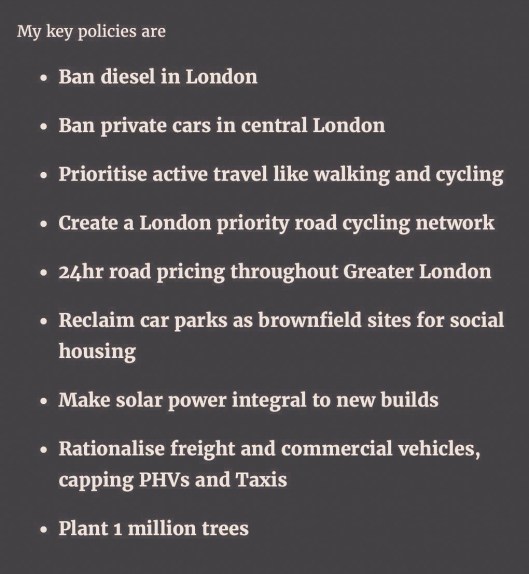
I stand by my policies for London 2016-2020 and will continue to campaign via my website banprivatecarsinlondon.com

I hope whoever succeeds as London Mayor will honour their duty of care to all Londoners, including children who make up nearly 25% of the population of the city. Cutting air pollution and safeguarding the freedom to roam safely by foot or on a bicycle, must be at the heart of a liveable city.

The next four years will be crucial in holding back global warming. Making a commitment to prioritise the transition to a sustainable city is paramount for a Mayoral legacy to future generations of this city and the wider global community.

image

Islington Gazette article by Sophie Inge

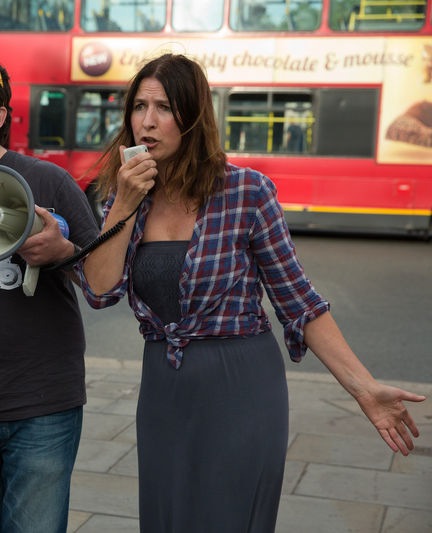
“Politicians are scared of the car lobby, and cars are one of the things they do not want to discuss,” she said. “I felt if they weren’t discussing something that is seriously affecting people’s lives and curbing people’s ability to naturally evolve in London and use space better, then I need to talk about this – and do it at a level where I can really make a change.”

photo(1)http://www.islingtongazette.co.uk/news/london_mayor_candidate_rosalind_readhead_the_islington_artist_who_wants_to_ban_cars_1_4450629

73